Choosing the Right Seating for Hospital Burn Units


Hospital burns units deal with a vast range of traumatic burns injuries, from thermal burns like scalding to chemical or electrical burns. The treatment provided and length of patient stay will depend on the severity of the burn, but the seating provided on the ward needs to accommodate all clinical needs from minor burns to the most critical.
This article looks at what seating features are needed to cover all eventualities in burns units and what chairs are best for these wards.
Jump straight to…
How Are Burns Treated?
Clinicians classify burns by depth and percentage of total body surface area (TBSA%). Depth can range from first-degree burns (superficial), to third-degree (full thickness) and even fourth degree for muscle and bone.
The combination of depth and TBSA% determines the severity of the burn, and certain areas of the body like the hands and face are classified as higher risk due to their potential impact on quality of life.
Practically, this means that hospital burns units can be treating a wide spectrum of patients at any one time. Some may be mobile within a few days where others may be facing surgeries, skin grafts, and months of rehabilitation. Therefore, the patient seating used on the ward has to cover all these eventualities, from minor right through to severe high TBSA% burns.

Want to replace your hospital seating?
Book a free seating audit
What Seating Features Do Burns Units Need?
Although important factors, burns unit seating requires more than just durability, comfort, and ease of cleaning. Burn injuries remove the skin, which is the body’s natural barrier against infection. This makes patients more vulnerable, even though burn wounds might be dressed and sterilised. Burn wounds weep significantly more than other wounds, producing extra fluids. Couple this with fragile skin grafts, impaired temperature control, and oedema management, and it is clear why burns units need a special category of seating specification.
Infection Control: The Non-Negotiable Factor
Infection control rules are very strict in burns wards and for good reason. Drug-resistant bacteria such as VRE can survive on fabric upholstery and cross-transfer to another patient up to a week later.
This is why upholstery coverings on the contact surfaces of the chair need to be impermeable (non-porous) and seam-free or heat-sealed, so there’s no way for bacteria to ingress into the structure of the chair.
Seams and stitching can also create points of entry for bacteria to lodge and escape disinfection, which welded or heat-treated seams can prevent. The fabric used also needs to tolerate the cleaning products which are often high-strength chlorine-based disinfectants.

Choosing Fabrics: Breathable, not Porous
When choosing fabrics for burns units, its important to understand the difference between ‘breathable’ and ‘porous’.
Porous, absorbent fabrics like suede or velour are ruled out, as they soak up fluid and bacteria into the fibres.
Vapour-permeable (VP) fabrics like Dartex work on a completely different principle.

Dartex Material
They have a solid polyurethane coating which is non-porous, yet vapour (water molecules) can still pass through. This is what makes the fabric ‘breathable’, as water molecules can escape which cools the surface of the skin. Viral penetration tests and hydrostatic pressure ratings are done on these fabrics to confirm that liquids, blood and viruses cannot pass through.
This makes vapour-permeable fabrics like dartex ideal for burns patients with fragile skin, as they are softer and breathable, as opposed to non-porous alternatives like vinyl which allow the build-up of moisture.
Vinyl is useful for the external surfaces of the chair, to protect against damage and scratches, but VP fabrics for the contact surfaces.
Not every fabric called ‘vapour permeable’ performs the same, so it’s worth asking manufacturers for their hydrostatic pressure ratings and viral barrier test results to ensure you have the right specification of fabric.

Properties of vapour-permeable fabric
Reducing Friction, Shear, and Pressure Injury Risk
Pressure injury is a risk factor for burns patient, but so is shear. Pressure injuries are caused by sustained loading on one area, whereas shear is internal damage between layers of skin tissue caused by sliding or dragging against the chair’s surface. On grafted or recently healed skin, that can happen more easily and do real damage.
Smooth fabric coverings with a low friction coefficient reduce shear risk, which is another reason VP fabrics score well. Beyond the fabric itself, chairs with adjustable or reclining positions for patients reduce the build-up of pressure, helpful for burn unit patients who may also be managing oedema or recovering their range of motion.
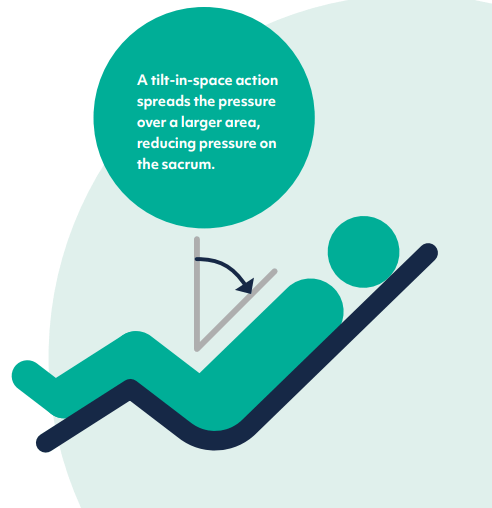
Tilt-in-space functionality
Heat Regulation: A Factor Specific to Burns Patients
Deep burns destroy sweat glands which don’t regenerate when the skin heals. Sweating is the body’s main cooling mechanism, so burns to larger surfaces areas can impair the body’s ability to regulate own temperature in warm conditions. Burn injury also increases heat loss damages the skin’s natural insulating properties, so a patient can struggle in both directions: overheating in warm rooms and losing heat too fast when skin gets exposed.
Fabrics can’t solve heat regulation, but shouldn’t make it worse. This is another reason why VP fabric is preferred over vinyl, as the breathability cools the surface of the skin.

Build and Frame Considerations
Other elements of the chair’s construction matter, such as sealed metal frames rather than wood that absorbs moisture over time. Velcro fastenings commonly used to attach cushions, harbour dust and bacteria in the same way fabric seams do, whereas magnetic or clip fastenings are far better for hygiene.
Modularity is an important feature if fabrics do get teared or damaged, so that components of the chair like arms and backrests can be swapped quickly rather than waiting to be repaired or manufactured.
Want to see our chair in action?
Book a seating demonstration
How We Apply This to our Seating Range
Lento Care Chair
The Lento Care Chair is our core recommendation for burns patients who are well enough to sit out for longer periods. It has the soft four-way stretch Dartex material on all contact surfaces, which protects the skin’s surface while keeping it cool and hydrated. It provides tilt-in-space for a more even weight redistribution and pressure relief, helping circulation and postural support. The sides of the chair remove easily for quicker cleaning, and the materials can withstand rigorous cleaning and infection control with machine-washable cushion covers. The Dartex range has an anti-microbial and anti-viral surface coating.

Little Lento Care Chair
The Little Lento is the scaled-down version of the Lento Care Chair, relevant for children’s burns units that treat paediatric patients.

Carer Pro Lie-Flat Chair
For patients with critical burns who may need to lie flat for longer periods and be moved with lines and dressings attached, the Carer Pro is a true lie-flat treatment chair designed for intensive and high-dependency care.

Seamless lie-flat surface. Seams and joins are places where bacteria can collect, and they can become pressure points for patients lying flat for hours. When fully laid flat, the Carer Pro’s backrest, seat and legrest form one continuous surface with no joins or gaps underneath the patient.
Pressure care. A gel seat cushion and an air cushion backrest are built into the chair.
Infection control. One continuous surface is ideal for infection control, and the plastic base cover protects against fluid ingress. Burn wounds weep more than most, so a surface that can be cleaned easily with no areas for fluid to lodge is important.
Gentler transfers. Drop-down wings and sides open the chair from both sides, so staff can transfer patients gently across without lifting over armrests, limiting friction and shear on fragile skin.
Vapour-permeable fabric. As explained above, vapour-permeable fabric is generally preferred for contact surfaces where skin is fragile, because it lets heat and moisture escape rather than trapping them against the skin. The contact surfaces of the Carer Pro use Dartex vapour-permeable fabric, for patients who spend long periods lying flat.
HiBack Bedside Chair
The HiBack is designed for more mobile patients who are or recovering but still need supportive, easy-clean seating at the bedside rather than full postural support. It’s constructed entirely from antimicrobial materials and has a highly supportive seat system with medium-risk pressure relief, highly recommended for lower-severity burns patients or visitor seating.

HiBack Bedside Chair
Conclusion
Seating plays an important role in infection prevention, skin protection, pressure management, and patient recovery throughout every stage of burns recovery. From patients with minor burns who require supportive bedside seating to those with extensive burns needing advanced pressure redistribution and postural support, patient seating must be designed to meet the unique clinical challenges of burn care.
Recommended Products

Lento Care Chair
The Lento Care chair has been clinically designed to address the complex care needs of anyone over 5’ 2”, particularly those who need to be hoisted.
Enquire About This Chair
HiBack Bedside Chair
Say goodbye to compromise, and hello to a generation of bedside chairs with game-changing levels of easy adjustability, patient care, and comfort.
Enquire About This Chair
Little Lento Care Chair
The paediatric Little Lento is a smaller version of our Lento Care Chair, for children and small adults up to 5’ 2”.
Enquire About This ChairFrequently Asked Questions


