• Key supplier to the NHS
  • Trusted by 19,000+ clinicians
  • Rated 4.8/5 by customers

Levitex foam technology

Advanced foam technology for pressure care

Pressure-relieving foam that helps patients move, not just sit still.

Levitex foam is clinically proven to relieve pressure, but unlike soft or air-filled surfaces, it keeps enough firmness for patients to feel where they are and move with confidence. That is the difference between a patient who stays in bed, and one who sits out, rehabilitates, and goes home sooner.

User testing also indicates that Levitex offers superior comfort to other foams and pressure relieving materials.

Peer-reviewed evidence Independent university testing Standard on every Lento chair
Levitex® Cradle Cushion
Peer-reviewed pressure care evidence
Peer-reviewed, Journal of Wound Care
Independent testing at Salford and UCLan, standard on every Lento chair
The clinical case

Comfort that gets patients moving again.

At Vivid Care, we hear the same story from wards and community teams across the country: a patient is medically fit to sit out, but the chair is uncomfortable and staff are worried about causing a pressure injury. This delay has a high cost. Time spent immobile in bed is time lost to deconditioning, and every extra day of avoidable bedrest makes the next stage of rehabilitation harder. Sitting out, properly supported, is one of the simplest and most effective interventions available to a therapy team.

Why patients stay in bed

  • Fear of causing or worsening a pressure injury.
  • The available chair is simply uncomfortable to sit in for any length of time.

Movement and rehabilitation benefits

  • Supports early mobilisation and re-adjustment to upright posture.
  • Helps regulate blood pressure after periods of bedrest.
  • Maintains muscle tone and slows deconditioning.
  • Conditions the body for standing and transfers.
  • Enables functional activity such as eating, reading and engaging with visitors.
  • Supports cognitive and social engagement, both linked to recovery outcomes.
  • Levitex-equipped seating is designed to remove both objections at once.
The differentiator

Most pressure cushions are built to be soft. Levitex is built to be movable.

Many pressure-relief surfaces, including air cells, gel pads and deep-envelopment foams, work the same way: they spread body weight by letting the pelvis sink in. That is effective pressure redistribution, but it comes at a cost that is rarely discussed. The same envelopment that protects skin also reduces proprioception, the sensory feedback a patient relies on to know where their body is and how to move it.

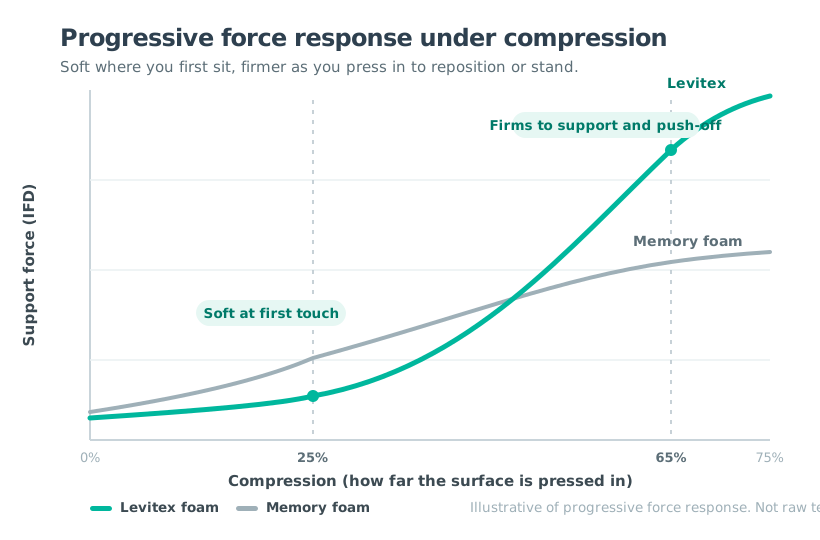
Levitex foam was engineered to close this gap. Its progressive-density structure behaves like a soft surface at rest, then firms when a patient shifts their weight to reposition or stand. This delivers the pressure protection clinicians require, without reducing the sensory feedback the patient needs.

Levitex® Cradle Cushion
How surface type affects movement

Tone, proprioception and ease of movement

1

Firm surface

Stable base under the pelvis. Increases tone. Easier to move.

2

Soft surface

Body sinks in. Decreases tone. Harder to move.

3

Highly malleable surface

Little consistent feedback. Reduces proprioception. Harder still.

Research-backed foam technology

Built with posture specialists. Proven through independent, peer-reviewed research.

We have partnered with Levitex Foams Ltd to bring this clinically-backed technology into our Lento seating range. Here is what the independent testing found, and what it means for the patients in your care.

Progressive force distribution

Soft at 25% compression, significantly more resistant at 65%, confirmed under IFD (Indentation Force Deflection) load testing. Independent review also showed a measurable increase in body contact area compared with memory foam.

Why it matters: this is what allows patients to push up and reposition, not just sit passively.

Source: IFD load testing, independent review.

Not thermosensitive

Levitex foam does not rely on body warmth to adapt its shape, so support is consistent from the moment a patient sits down.

Why it matters: full pressure protection from first contact, with no waiting for the cushion to adjust before it starts working.

Source: material specification.

Faster rate of return

Ball resilience testing shows Levitex foam recovers its shape faster than memory foam, supporting repositioning throughout the day rather than staying compressed.

Why it matters: supports more frequent, effective repositioning, a core plank of pressure injury prevention.

Source: ball resilience testing.

Independently and peer-reviewed tested

In an independent study of 27 volunteers published in the Journal of Wound Care, the Levitex surface produced significantly lower peak pressure than a standard hospital surface and a dynamic airflow surface, cutting head and heel pressure by more than 30% against both.

Why it matters: skin protection you would expect from any clinical-grade foam, plus the movement benefits standard foam cannot offer.

Source: Webb and Chohan, Journal of Wound Care 32(8), DOI 10.12968/jowc.2023.32.8.513.

What sets it apart

Three qualities clinicians notice within the first sitting.

Makes an early sit-out easier

Rated higher for comfort than standard hospital surfaces in independent testing, removing one of the main barriers to mobilising early.

Support patients can feel and move against

Patients keep a clear sense of where their body is in the seat, even under full load, the feedback they rely on to reposition and prepare to stand.

Built for the whole day

Faster shape recovery and a stable, non-thermosensitive structure mean the same support is there for the first sit-out of the morning and the last of the evening.

“I can wriggle and move on this cushion. The other one makes me feel trapped. Wriggling is good.”

Occupational Therapist and stroke survivor

Integrated into our seating

The Levitex Cradle Cushion, standard on every Lento chair.

Our own engineering, built around Levitex foam.

We did not simply drop Levitex foam into an existing cushion. Our product design team engineered the Levitex Cradle Cushion from the ground up, shaping the foam precisely to the contours of the thighs and pelvis for additional pressure relief and optimum alignment, then layering it with two further grades of precision foam for stability and support.

It is engineering we are proud to have built in-house, and it comes as standard across the Lento range, part of delivering world-class comfort for every client at no additional cost.

  • Contact layer
  • Support layer
  • Base stability layer

Backed by independent research

Developed with posture specialists. Verified independently.

Every finding referenced on this page is drawn from independent university testing or peer-reviewed publication. Full methodology and results are available for your own clinical governance review. University of Salford. University of Central Lancashire. Journal of Wound Care.

Common questions

From clinicians who have asked us first.

If Levitex foam is firmer, does it still relieve pressure?

Yes. In an independent 27-volunteer study published in the Journal of Wound Care, Levitex significantly reduced peak pressure compared with a standard hospital surface and a dynamic airflow surface, cutting head and heel pressure by more than 30% against both. Firmness under higher load and pressure redistribution are not mutually exclusive. Levitex foam’s progressive density is designed to deliver both.

See it on your ward before you decide.

Whether you are assessing one patient or reviewing a fleet of chairs for a whole unit, our clinical team will bring the evidence, the chair, and the cushion to you.

Content on this page is for clinical and educational purposes and does not replace individualised patient assessment.

icon_bluestone98