Best Chairs for Lateropulsion


Lateropulsion is a sitting characteristic seen in post-stroke recovery where a person moves their body towards their weaker side.
This active neurological behaviour needs a unique approach to rehabilitation which we look at in this article, including why it happens, and what to look for with seating whether that’s in a stroke ward, rehabilitation unit or at home.
Jump straight to…
What is Lateropulsion?
Lateropulsion is a recognised clinical term used when a stroke patient actively pushes themselves away from the midline towards their weaker side when sitting. This is done subconsciously and can create resistance to being moved back to a central position, becoming difficult to correct.
Lateropulsion should be distinguished from more general ‘leaning to one side’ which is a postural issue we cover in our guide How to Stop Someone Leaning to one Side in a Chair.
It affects roughly a quarter of stroke survivors and is more associated with right-hemisphere strokes. It was first described as ‘pusher syndrome’ in 1985 by physiotherapist Patricia Davies and is also known as ‘pusher behaviour’, ‘contraversive pushing’ and ‘ipsilateral pushing’.
What Causes Lateropulsion?
Lateropulsion is caused by impairment to the brain’s sense of vertical alignment – the network that tells us which way is up and which is down.
Research has shown that this involves several areas of the brain:
- The posterolateral thalamus
- The posterior insular cortex
- The postcentral and inferior frontal gyrus
- The inferior parietal lobe
Therefore, it is the size of the area of stroke damage that will determine whether someone will experience this condition.

Have a Patient with Lateropulsion?
Book a postural review
How Does Lateropulsion Differ from Ordinary Leaning?
Lateropulsion shouldn’t be confused with passive leaning to one side, which can be due to a range of postural issues.
If someone has a more general postural lean, our guide to leaning to one side in a chair covers how to correct this with seat sizing, lateral supports and cushion options.
The below table sets out the key differences between lateropulsion and ordinary leaning.
Ordinary leaning | Lateropulsion | |
Cause | Muscle weakness, poor postural support, musculoskeletal disorders | A disrupted sense of vertical balance |
Awareness | Person is aware of instability | Person thinks they are sitting upright |
Behaviour | Body drifts to one side under gravity | Person pushes their body to one side using their other stronger side |
Trigger | Parkinsons/dementia, scoliosis, osteoporosis, unsuitable seating | Stroke, especially right-sided or larger lesions |
Seating strategies | Correct size, lateral cushions and waterfall backrests | Retraining, tilt-in-space, careful use of lateral props |
Assessing for Lateropulsion
As the patient isn’t aware of their imbalance it can be missed in therapy visits, so needs a proper clinical assessment.
There are standard measurement techniques used by physiotherapists and OTs such as Scale for Contraversive Pushing (SCP) and Burke Laterpulsion Scale (BLS).
If you’re caring for someone who has had a stroke and is leaning heavily and resistant to sitting upright, it’s best to carry out a seating and postural assessment to determine whether this is lateropulsion.
Need Seating for Stroke Patients?
Book a seating assessment
Features to Look for in Chairs for Lateropulsion
Rather than being a fixed deformity, lateropulsion is a condition treated as part of stroke rehabilitation, so the choice of chair should support the clinical goals set by the MDT rather than just a bolt-on solution.
These are some of the key features to consider:
Tilt in space
Rather than just backrest recline, the whole seat should tilt to redistribute vertical pressure and encourage a more centralised posture. This is a good position for therapists to work on postural retraining as it makes it easier to reposition them and avoids shear friction.
The locking tilt in space function on the Lento Care Chair can be easily adjusted to the desired angle using the tilt lever on the push handle, or via the handset on the electric version.
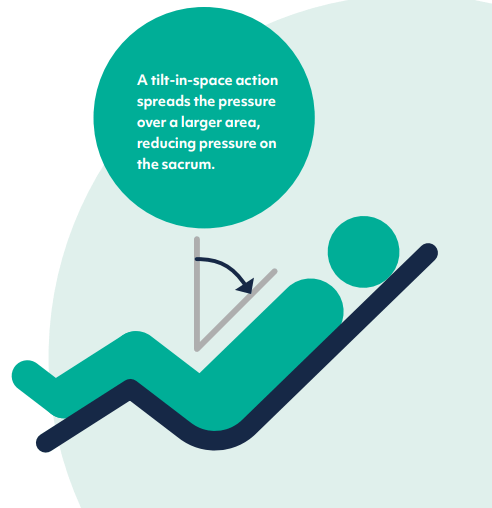
Tilt-in-space functionality
Visual Cues
Positioning the chair to face a clear vertical reference point, like a doorway or window frame can be really helpful for stroke survivors to learn what upright looks and feels like. Choose a room layout that supports this kind of visual feedback for the therapy programme.

Adjustable Lateral Support
Contrary to a general lean, lateropulsion isn’t corrected just by ‘propping’ the person upright with a lateral support, since relying on just physical supports can slow down the retraining of someone’s sense of balance.
Using lateral support that can be added, adjusted and then removed gradually as recovery progresses is much more useful for clinicians.
Look out for modular chairs with removeable and interchangeable backrest cushions like the Lento Mobile Riser Recliner. The waterfall backrest has a lateral support cushion that can be moved, swapped out, with each cushion adjustable with zips to add or remove wadding.

Stable and supportive seat base
A stable and supportive seat cushion, and seat height that allows feet to be placed flat on the floor or a footplate, gives an important sensory foundation for helping to correct posture.
Our Levitex seat cushion uses foam technology with a higher rate of return that supports posture when repositioning, rather than conforming to the lean like memory foam. This cushion comes as a standard on the Lento Care Chair and is available as an extra on the Lento Mobile.

Levitex Cradle Cushion
Ease of transfer
Many patients require assisted transfers in the early stages of stroke recovery, so ensure compatibility with mobile hoists or standaids.
All our Lento chairs are hoist and Sara Stedy compatible, and have removeable arms for lateral transfers.

Portability
Stroke recovery tends to work through different environments, from the acute ward to rehabilitation units then home, so a chair that’s easy to reposition and move from one area to another is important for continuity of care.
The Lento Mobile is designed for portering, with a narrow profile, height adjustable push handle and smooth rolling castors.
If you’re looking more broadly at seating for stroke recovery, read our article on the best care chairs for stroke patients.
Best Chairs for Lateropulsion
Lento Care Chair
The Lento Care Chair is designed for hoisted patients and has the built-in adjustability that neuro rehabilitation wards need.
It’s locking tilt-in-space gives a secure position to work from for redistributing pressure and postural retraining. The seat depth, width and arm height can all be adjusted without tools, which is useful for multi-user settings where the chair needs to be configured to different patients.
The backrests are interchangeable between waterfall, lateral and cocoon versions, with extra options like extended wings and leg laterals to vary the level of lateral support. The removeable arms make side transfers easier during the early stages of stroke recovery.

For the most complex of cases, the Lento Cove Care Chair is a gamechanger with the incredibly adjustable SpineSupporter™ backrest.
Lento Mobile Riser Recliner
For rehabilitation patients who need to be moved between settings, for example from the ward to therapy room or bedside to dayroom, the Lento Mobile offers the same level of care chair comfort on a portering base, so patients don’t have to be transferred when moved around. If assisted transfers are needed from bed to chair, the Lento Mobile is compatible with hoists or any other form of transfer be it standing, standaid, transfer aid, or side transfer.
The smooth-rolling braked castors and adjustable push handle make portering easy, and it shares the same magnetic backrest and cushion system as the rest of the Lento range, making it easy to adjust lateral support.

Both chairs come with the lateral waterfall backrest as standard, but extra accessories are available such as the cocoon backrest, backrest wedges and metal lateral supports.
Conclusion
Lateropulsion is a neurological behaviour that develops after a stroke, and is distinct from a general sidewards lean caused by other neurological or musculoskeletal conditions.
Professional assessment tools are essential to diagnose this before seating or rehabilitation plans can be put in place.
While seating is not a standalone cure for this condition, it plays a supporting role in the wider MDT strategy for stroke recovery.
Recommended Products

Lento Care Chair
The Lento Care chair has been clinically designed to address the complex care needs of anyone over 5’ 2”, particularly those who need to be hoisted.
Enquire About This Chair
Lento Cove Care Chair
The Lento Cove Care Chair provides a premium level of postural support, for even the most complex needs.
Enquire About This Chair
Lento Mobile Riser Recliner Chair
The Lento Mobile riser recliner chair and care chair hybrid offers easy portability on smooth gliding braked castors, and with an ergonomic push handle.
Enquire About This ChairFrequently Asked Questions


