What NHS England’s Model Discharge Pathway Means for Ward Seating


Jump straight to…
What is NHS England’s Model Discharge Pathway?
Deconditioning has gone from being a clinical argument to an evidence-based care pathway that has to be followed throughout all hospital wards.
The new NHS England Model Discharge Pathway brings together previous discharge guidance into a single operational framework. As operational guidance, it is not simply advisory; it establishes expectations that discharge teams, wards and hospitals will be measured against.
The model is built around several principles:
- Staying in hospital longer than necessary is not neutral; it causes harm.
- Preventing deconditioning begins from the point of admission.
- Discharge planning should start early and continue throughout the admission.
- Patients should be supported to maintain or regain function wherever possible.
Those principles have significant implications for ward environments, particularly seating.

What This Means for Ward Seating
NHS England focuses on the following outcomes in the Model Discharge Pathway:
- Maintaining independence
- Preventing deconditioning
- Supporting mobility
- Reducing avoidable delays
- Enabling discharge
These outcomes are heavily influenced by whether patients spend their day in bed or out of bed.
Research consistently shows that hospitalised older adults spend most of their day inactive. NHS England cites evidence that patients spend around 83% of measured daytime hours lying down, while one-third of those affected are aged over 70.
If a patient is expected to spend enough time out of bed, then the chair becomes part of the clinical pathway.
An unsuitable chair can discourage mobilisation, increase fatigue, create transfer difficulties and increase pressure damage risk. A suitable chair can help maintain muscle strength, support safe transfers and make it easier for patients to participate in therapy and daily activities.

Deconditioning prevention starts with getting patients out of bed
The Model Discharge Pathway reinforces a growing NHS consensus that deconditioning prevention is not a therapy activity that happens later in a stay, it starts immediately.
It starts immediately. Instead of asking “What chair do we need for patients who can’t mobilise?”, the question becomes “What chair helps patients maintain mobility and independence throughout their admission?”
A chair that supports standing, transferring, repositioning and participation in everyday activities contributes directly to the pathway’s objectives.
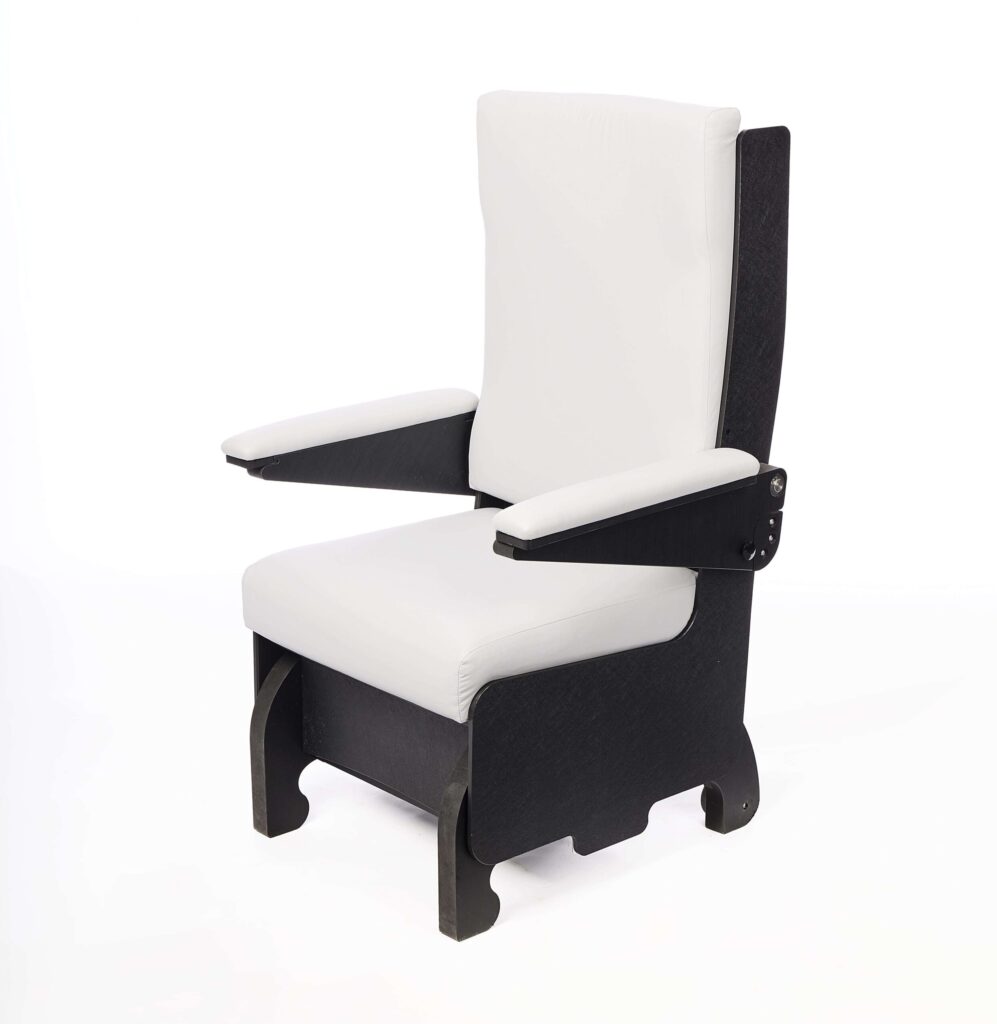
The HiBack Bedside Chair supports these activities with the following features:
- Flip-back armrests for easy side transfers
- Adjustable seat width, depth and height
- Adjustable lumbar support
- Easy portability with wheels and handle
- Levitex foam and 4-way stretch fabric

Need Chairs That Maintain Mobility and Independence?
Upgrade Your Hospital Ward Seating
Discharge lounges – Equipment Requirements
One of the clearest operational consequences appears in discharge lounges.
The Model Discharge Pathway states that discharge lounges should be able to accept non-ambulant patients. This is a significant change in expectation.
Historically, many discharge lounges have been equipped more like waiting areas, with standard waiting-room seating designed for short stays and mobile patients.
If non-ambulant patients are expected to use these spaces safely, seating requirements change substantially.
Organisations may need:
- Chairs suitable for hoist transfers
- Seating with pressure management features
- Supportive armrests to aid transfers
- Higher safe working loads
- Clinical cleaning compatibility
- Seating appropriate for longer occupancy periods
In effect, discharge lounges become an extension of the clinical environment rather than a transport waiting area.
Chairs that support the needs of non-ambulant patients in discharge lounges include:
Lento Mobile Riser Recliner
As a hybrid between a riser recliner and a care chair, the Lento Mobile is suitable for hoist transfers but maintains the portability of a riser recliner chair.
- Smooth gliding castors for easy portability
- Compatible with hoists or standaids like Stand Assist
- Tilt in space
- Removeable and height adjustable arms for transfers and tailored support

Lento Mobile Rise Recline Chair
QuickCare Pro Lie-Flat Chair
- Hi-Lo Adjustment
- Removeable armrests
- Range of armrest positions
- Dual Controls

QuickCare Pro
Need to Discharge Patients Faster?
Find Seating for Your Discharge Lounge
Seating – an important part of discharge equipment
The pathway repeatedly emphasises reducing delays and avoiding unnecessary bed occupancy.
The average delayed discharge remains significant, with NHS England reporting an average delay of 6.1 days and more than 324,000 bed days lost.
Many factors contribute to these delays, but functional decline is one of the most important.
When patients lose strength during admission, discharge becomes more complex. Additional therapy input may be required, care packages may need reassessment, and previously achievable discharge destinations may no longer be suitable.
Good ward seating will not solve delayed discharge on its own.
However, seating that supports mobilisation, independence and participation can remove one of the barriers that contributes to deconditioning in the first place.

What chairs should procurement teams look for?
The Model Discharge Pathway suggests that seating decisions should be evaluated against a simple question:
“Does this chair help the patient maintain function and progress towards discharge?”
That means considering:
Seating Requirement | Why it matters |
Supportive armrests | Help patients perform sit-to-stand transfers independently where possible |
Pressure redistribution | Supports patients who spend prolonged periods seated and reduces pressure injury risk |
Repositioning compatibility | Allows nursing teams to maintain repositioning schedules |
Hoist accessibility | Supports safe transfers for non-ambulant patients |
Mobility and transportability | Enables patients to move between ward, therapy areas and discharge lounges |
Infection prevention compatibility | Supports routine cleaning and maintenance requirements |
Adjustability | Accommodates a wider range of patient sizes and functional abilities |
Conclusion
By making early mobilisation and functional independence central to discharge planning, NHS England has effectively raised the importance of seating throughout the patient journey.
The question is no longer whether a ward chair is comfortable enough for a patient to sit in.
The question is whether that chair actively supports the hospital’s ability to prevent deconditioning, maintain independence and achieve timely discharge.
In that context, seating stops being a facilities purchase and becomes part of the discharge pathway itself.
Recommended Products

Lento Mobile Riser Recliner Chair
The Lento Mobile riser recliner chair and care chair hybrid offers easy portability on smooth gliding braked castors, and with an ergonomic push handle.
Enquire About This Chair
HiBack Bedside Chair
Say goodbye to compromise, and hello to a generation of bedside chairs with game-changing levels of easy adjustability, patient care, and comfort.
Enquire About This ChairQuickCare Pro Lie-Flat Chair
The QuickCare Pro is an extremely versatile lie-flat chair, designed to adapt to wide array of different acute care settings, from day surgery through to dialysis and oncology.
Enquire About This ChairFrequently Asked Questions