The Ultimate Pressure Sore Cushion: How Levitex Changes Pressure Care


When thinking about pressure sore cushions and what foam to use in seating systems, it can be tempting to think the softer the foam, the better.
In fact, this can be one of the biggest mistakes made when choosing a seat cushion for effective pressure care. For the most effective pressure care strategies, seat systems require a balance between pressure redistribution, comfort, posture support and enabling movement.
This article introduces the unique Levitex foam technology in our seating, and how it solves the challenges with some of the traditional pressure care materials.
Jump straight to…
What Makes a Pressure Sore Cushion Effective?
To start with, it’s good to remind ourselves what we need a pressure cushion to achieve when formulating a pressure care strategy for a client.
Pressure redistribution
A cushion that spreads weight evenly across contact surfaces avoids the build-up of pressure points, which can lead to pressure sores forming. The highest pressure point when sitting on a cushion can be identified by colours on a pressure mapping device, which is known as ‘peak pressure’. This score is reduced by spreading pressure more evenly and increasing surface contact area.

Pressure mapping image of a person sitting in a chair.
Supporting posture
A good pressure cushion needs to fundamentally support good posture, because pressure relief cannot be achieved without good posture as a starting point.
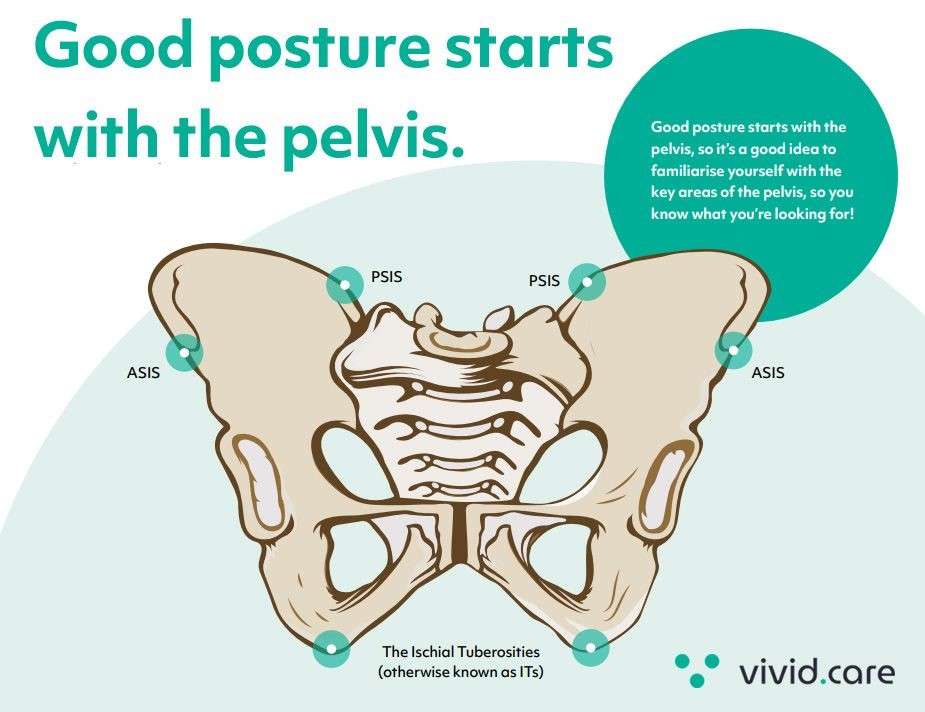
If the pelvis is misaligned in the chair, this creates an uneven loading on sensitive areas of the body and can lead to pressure sores.
Reducing shear forces
As well as reducing pressure, a suitable cushion and fabric needs to help prevent shear injuries, which happens when the skin surface is pressed against the surface of the chair and causes damage to underlying tissues. This can be achieved by using a stretch fabric that moves with the body rather than against it.
Enabling movement
The key to preventing pressure build-up is allowing for movement and repositioning, so a pressure cushion should make this is easy as possible. Foams that compress too much cause the user to ‘sink into’ the cushion, making it harder for them to shuffle forwards or side-to-side.
Posture is never a ‘fixed’ position, and we naturally move and shift our sitting posture throughout the day, so having a cushion that facilitates this as much as possible allows for better pressure redistribution.
Not Sitting Comfortably?
Book a pressure care seating assessment
Limitations of Traditional Pressure Cushions
Memory Foam
Memory foam has become very popular over the years particularly with mattresses, due to the enhanced comfort it provides by conforming to the user’s body shape.
However, this has drawbacks for clients needing higher pressure relief, for two reasons:
- It can destabilise sitting posture easier if someone leans to one side, as it conforms to indentation force rather than deflects it.
- The higher immersion of memory foam makes it harder to patients to reposition themselves on the cushion and mobilise to stand.

Gel Cushion
With individual gel pads, gel cushions redistribute pressure well across the cushion as well as keeping the skin cool by conducting heat away from the skin.
However, rather than providing increased firmness and sensory feedback when under load, the gel can move to each side of the individual cells, causing higher immersion of the body into the cushion and even causing the gel to migrate between cells, creating an uneven surface.

Coolgel pad
Air cushions
Air cushions are made up of individual air cells which inflate and deflate alternately, causing continual redistribution of pressure. This is great for higher need users, and alternating air cushions can be integrated into our standard chairs by cutting out the seat cushion.
However, the higher maintenance requirements and fault potential of these cushions can make them more impractical for some specialist seating users.

Introducing Levitex: A New Approach to Pressure Care
Levitex foam was integrated into our seating range on the back of its success as a sleep surface, increasing proprioception and improving posture and comfort through its lower pressure scores when compared to alternatives.
Since its transition into seating, Levitex foam has consistently scored lower peak pressure and higher levels of perceived comfort when compared against traditional surfaces.
This is due to its progressive firmness under load. When the patient first comes into contact with the foam it is soft at 25% compression, but increases in firmness as the patient’s weight sinks into the chair. This boosts sensory input, and supports sitting posture.
We’ve taken this a step further in our patented Levitex Cradle Cushion, which has three layers of different density foam to provide a stable base, contoured to the shape of the thighs for better pelvic alignment. This comes as standard across our Lento range, as part of our mission to deliver world-class comfort for every client.

Levitex Cradle Cushion
Discover Levitex Foam
Learn more about Levitex foam technology
What Makes Levitex Different?
Levitex addresses common limitations found in traditional pressure care cushions, such as gel, air and memory foam. These surfaces work in similar ways in that they allow the person’s body weight to sink into the chair to spread body weight across contact surface areas.
While this reduces pressure, it also reduces the sensory feedback the patient needs to feel themselves in the chair and move against the cushion when standing or transferring.
The advantage of Levitex foam is that the unique molecular structure of the foam makes it soft to touch when resting, but it has a faster rate of return when body weight shifts, supporting someone when they want to reposition or stand.
Feature | Traditional foam | Gel | Air | Levitex |
Pressure redistribution | ✓ | ✓ | ✓✓ | ✓✓ |
Supports movement | Variable | Variable | Variable | ✓ |
Lightweight | ✓ | ✗ | ✓ | ✓ |
Maintenance required | Low | Low | Higher | Low |
Designed around movement | Limited | Limited | Variable | ✓ |
Clinical Evidence Behind Levitex Foam
Levitex has undergone rigorous independent testing, including a 27-volunteer study published in the Journal of Wound Care. This study concluded that it produced significantly lower pressure indices than standard hospital and dynamic airflow surfaces. It was also found to create a larger body contact area than memory foam and spread pressure more evenly.
IFD (Independent Force Deflection) load testing found Levitex to be soft at 25% compression, increasing under resistance to 65%, which is what makes it easier for patients to push themselves up in the chair and reposition, rather than just sit passively.
This was described well by an occupational therapist and stroke survivor who is a firm fan of Levitex: “I can wriggle and move on this cushion. The other one makes me feel trapped. Wriggling is good!”
Conclusion
An effective pressure sore cushion should do more than simply feel soft. It needs to redistribute pressure, support posture and allow movement. Levitex foam takes a different approach by combining pressure redistribution with progressive support, helping users stay comfortable while making repositioning easier. As always, the right cushion should be chosen as part of an individual pressure care assessment.
Recommended Products

Lento Care Chair
The Lento Care chair has been clinically designed to address the complex care needs of anyone over 5’ 2”, particularly those who need to be hoisted.
Enquire About This Chair
Lento Cove Care Chair
The Lento Cove Care Chair provides a premium level of postural support, for even the most complex needs.
Enquire About This Chair
Lento High Pressure Relief Gel Cushion
High-performance gel cushion for pressure redistribution.
Enquire About This ChairFrequently Asked Questions