How to Find the Best Chair for Hospital Wards


Choosing the right chair for hospital use isn’t always straightforward, as every ward has different demands and every patient has different needs.
This article explains what makes a chair suitable for hospital use, the main types of chairs you’ll come across in clinical settings, and how NHS Trusts typically go about buying them. Whether you’re a ward manager reviewing your current seating stock or an OT specifying equipment for a particular patient, you’ll find a clear overview of what to look for and where to start.
Jump straight to…
What is a hospital chair?
A hospital chair is a generic term that covers a wide range of different chairs used throughout acute care settings. As well as ensuring comfort which is an essential feature of every patient chair, they are designed with specific clinical needs and treatments in mind, depending on the ward or hospital setting.

Need a Review of Your Hospital Seating?
Book a seating audit
Essential Features for Hospital Chairs
Infection Control
Infection Prevention and Control is of paramount importance in hospitals and this needs to be at the core of any chair used in hospitals. Minimal fabric seams and recesses and infection-friendly materials and fabrics are key features that can help achieve this.
We have integrated the highest infection control standards across our seating range, such as minimal seams and recesses, removeable upholstery for decontamination, and using clasps and magnets instead of Velcro.
Mobility
Moving chairs between beds, down narrow corridors and in lifts creates unmanageable strain for carers if the chair is not designed to be manoeuvred easily.
Ease of movement is critical for fast-paced clinical environments, where nurses need to move the chair around the wards and between different locations in the hospital.

Pressure Care
Especially for longer hospital stays of a few days, pressure care is not only critical for the patient’s comfort but protecting their skin integrity and preventing pressure sores or infections.
The chance of pressure ulcers developing in hospitals is higher, therefore pressure relief must be a key consideration in the design of the chair.
Patient Mobilisation
It has long been established that getting patients mobilised as quickly as possible is important to ensure a good recovery and reduce the risk of DVT and deconditioning. This is also important for the hospital to reduce patient bed days and improve patient flow, so needs to prioritised in the chair’s design.
Seating Standardisation
When chairs can be applied to a wider range of clinical applications, the number of different chairs required dramatically decreases, simplifying procurement, staff use and maintenance.
This is central to our policy of seating standardisation, which we use in hospital seating audits to refine and simplify their ranges.
Durability
Chairs need to be able to stand up to constant heavy use in hospitals, which requires a strong frame and motors, tear resistant fabrics, strong castors and breakaway charge cables.
Want to Trial a Chair in Your Hospital Ward?
Book a chair trial
What chairs do hospitals use?
The range of different hospital settings calls for a diverse range of seating, from simple bedside chairs to more clinical ICU and treatment chairs.
These are the main types of hospital chairs to be found in acute care environments.
Patient & ward chairs
Bedside chairs are the mainstay of hospital wards and inpatient units, commonly seen through geriatric, general medicine, and rehabilitation to more specialist wards like oncology and cardiology.
They are a standard fixture of bed bays in multiple occupancy wards, positioned at the side of the bed for the patient to sit out in before or after treatment, where they can eat meals, read, or receive regular nursing checks.
Traditionally these have been vinyl-upholstered high seat chairs with wooden frames, which has been overhauled with the introduction of the HiBack Bedside chair, launched to solve the problems of poor infection control, hard uncomfortable chairs and difficulties with moving and adjusting them.

HiBack Bedside Chair
Medical recliners & treatment chairs
When patients need to sit out for longer and care is more closely monitored over longer hospital stays, the level of clinical features in the chair has to reflect this. Recliner chairs with tilt in space and recline are needed here so the patient can be repositioned for more comfort. The grade of fabric and pressure relief has to be antimicrobial and comfortable for longer periods of time, like a VP or stretch fabric.
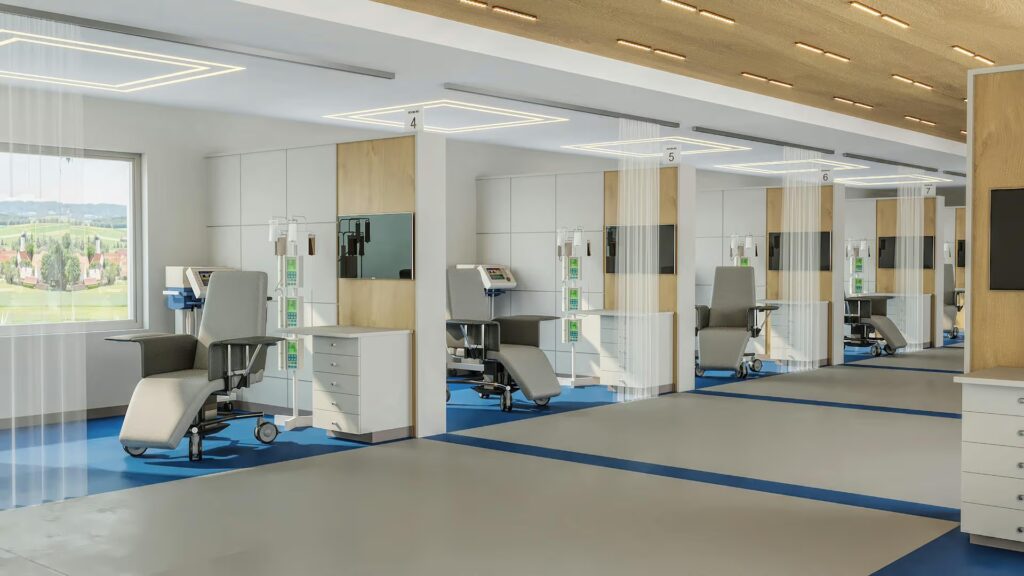
Acute care environments have a range of treatments like dialysis, oncology, haematology and minor surgery. These all have different positioning requirements, and it has historically been hard to come by a chair that can used across all these different settings.
Now with the Quickcare Pro Lie-Flat Chair, the patient can use the same chair through the entire acute care pathway, with its incredible range of adjustment from lie-flat through to standing. The Quickcare has an amazing versatility to adapt to different procedures like blood tests, using the multiflex armrests to achieve the correct arm positioning.
QuickCare Pro Lie-Flat Chair
Sleeper chairs
Sleeper chairs are armchairs that fold out into beds, useful for visitors and overnight stays. They are good for maternity and paediatric wards where family members may need to stay with their loved ones in hospital.
Having a chair that can fold out into a bed like this is an efficient use of space, making them ideal for small patient rooms.
Intensive Care Seating
Chairs in intensive care and critical care wards need a higher level of clinical support, with features such as lie-flat and removeable sides to make transfers easier.

Patients in these areas are receiving vital organ support, so the chair needs to facilitate emergency procedures like CPR or Trendelenburg positioning.
The Carer Pro Lie-Flat chair is designed for ICU procedures, and converts quickly into from normal upright position down to a stretcher-style lay flat position, with electric Hi-Lo adjustment for carer access.
Portering and transit chairs
Portering chairs are useful to take patients down to the operating theatre between different areas of the hospital. As well as standard portering chairs which have a larger seat base and castors, there are more compact mobile recliners available such as the Lento Mobile or Levara.

Levara riser recliner chair
These chairs double up well as a comfortable recliner that can be moved easily around the ward, and are useful for geriatric or rehabilitation wards that may be using physio to help patients get mobile. They assist the patient with sitting and standing, using the electric rise function and are compatible with standing aids like the Stand Assist.

Clinical care chairs
When higher levels of postural support are needed, care chairs are the perfect option. This could be for orthopaedic patients, or elderly and less mobile patients that need hoisting.
Care chairs are designed for head-to-toe postural support, with the ability to build in extra postural support and pressure relief where required to keep the patient secure and comfortable.
The Lento Care Chair is the standard care chair in our range, with all seat dimensions fully adjustable to suit each user.

Specialised Seating
Seating may need to be size-specific or cater to the special needs of individual patients.
Paediatric Care – the Little Lento is the sized-down version of the Lento care chair, for children and smaller adults.
Bariatric Care – heavy-duty riser recliners can be specified with 40 or 50 stone weight limits, and the bariatric care chair is available for bariatric patients who cannot self-mobilise.
Neurological Care – the Lento Neuro has a cocooned seat and lower seat rake to reduce involuntary movements.
As well as patient needs, the type of clinic may have very specific seating requirements, such as elective screenings and blood tests.
Mammography – breast screening has very specific patient positioning requirements, which the VELA Mammography chair has been designed to achieve while minimising strain for mammography staff.
Phlebotomy – taking blood samples needs bespoke seating with the ability to position the arms easily at the right angle, which the VELA Phlebotomy chair helps to achieve.
Need a Seating Demonstration
Book an on-site demonstration
How can I buy a chair for hospital?
Purchasing patient seating in hospitals is usually the responsibility of ward managers and OTs, but depends on the Trust’s procurement policies and whether they purchase through capital or revenue budgets.
There are a variety of procurement frameworks used, depending on the policy of the NHS Trust.
The NHS supply chain is the central procurement team for the NHS, with an approved list of suppliers. Other procurement routes include framework agreements, tenders and Service Level Agreements.
At Vivid Care we only use the highest standards in our construction to ensure maximum longevity and reliability. Most of our seating range is made in Britain, and we comply with the highest infection control standards using antimicrobial fabrics and patented manufacturing methods.
Conclusion
There’s no single best chair for hospital wards, the right choice always comes down to the clinical setting, patient group, and the practical demands of the ward itself.
What stays constant across every category from bedside chairs to ICU seating is the need for strong infection control and durability that can withstand daily clinical use.
Standardising seating where possible can make a real difference to procurement, training, and maintenance, without compromising on the specialist features certain wards require. If you’re reviewing your current hospital chair stock, a seating audit is a useful first step to identify gaps and opportunities to simplify your range.
Get in touch with Vivid Care for a no-obligation seating audit, or to discuss which chairs would suit your ward’s specific needs.
Recommended Products

HiBack Bedside Chair
Say goodbye to compromise, and hello to a generation of bedside chairs with game-changing levels of easy adjustability, patient care, and comfort.
Enquire About This Chair
QuickCare Pro Lie-Flat Chair
The QuickCare Pro is an extremely versatile lie-flat chair, designed to adapt to wide array of different acute care settings, from day surgery through to dialysis and oncology.
Enquire About This Chair
Levara Rise and Recline Chair
The Levara is a basic-spec riser recliner built for busy healthcare settings that demand functionality and affordability.
Enquire About This ChairFrequently Asked Questions


